Recovering The Excitement Of The Picture Postcard
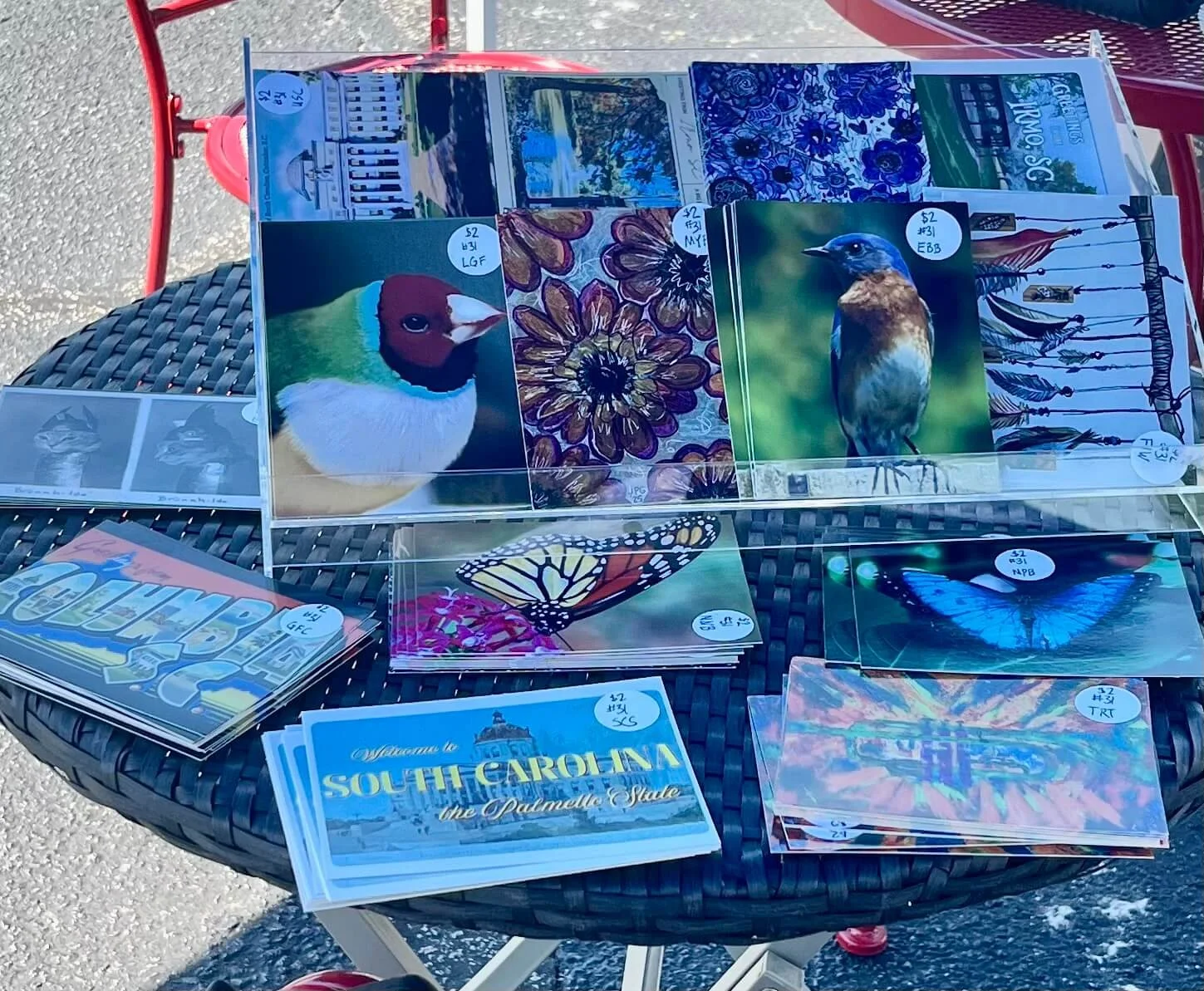
A postcard display outside Woodrow Marketplace in Irmo, SC.
In an era when almost everyone on earth can stream live video around the globe instantly, it may be hard to believe there was a time when much of the world was obsessed with sending postcards. But, when first introduced in Europe in the late 19th Century, this new communication space was quite literally a game changer.
Writing in the early 1900s, London journalist James Douglas said, “When the archaeologists of the thirtieth century begin to excavate the ruins of London, they will fasten upon the Picture Postcards as the best guide to the spirit of the Edwardian era. Like all great inventions, the Picture Postcard has wrought a silent revolution in our habits. It has secretly delivered us from the toil of letter-writing.” (emphasis added)
Douglas added, “There are men still living who can recall the days when it was considered necessary and even delightful to write letters to one's friends. Those were times of leisure. Happily, the Picture Postcard has relieved the modern author from this slavery. He can now use all his ink in the sacred task of adding volumes to the noble collection in the British Museum.”
Expanding on this, Douglas wrote:
“Formerly, when a man went abroad he was forced to tear himself from the scenery in order to write laborious descriptions of it to his friends at home. Now he merely buys a picture postcard at each station, scribbles on it a few words in pencil, and posts it. This enhances the pleasures of travel. Many a man in the epistolary age could not face the terrors of the Grand Tour, for he knew that he would be obliged to spend most of his time in describing what he saw or ought to have seen. The Picture Postcard enables the most indolent man to explore the wilds of Switzerland or Margate without perturbation.”
(Quoted in The Picture Postcard & Its Origins by Frank Staff —1979, Lutterworth Press)
The postcard took hold of Europe in the early 20th Century and was quickly recognized as a social phenomenon with considerable impact.
Today, we have largely moved on from postcards and letters in favor of emails and social media. But that’s unfortunate. Because it has cheapened the quality of our communication and pushed us further into isolation.
Perhaps recovering the epistolary excitement of the Edwardian era and embracing the joy of the simple picture postcard can allow us to use an old technology to connect in a new way. Because, for me, the thrill of sending a postcard sure beats the short rush of posting on social media and the joy of receiving a postcard beats the minor dopamine hit of scrolling a feed.
— Adam