Postcard Etiquette: What To Write On A Postcard
A tiny keepsake that speaks louder than a text message or social media post, the postcard offers a brief, tangible, and personable space to connect with someone else. And the right words can turn a simple snapshot into a memorable communiqué.
Postcards are built for brevity, but that doesn't mean your message should be bland. Whether you're writing a quick hello from a restaurant, a thoughtful note at a coffee shop, or a playful update while on vacation, you’ll want to consider the tone, structure, and specific phrases that fit the recipient and the moment. Remember, you only have so much space.
So, let’s begin by looking at the physical space of the postcard. On one side, you will find an image of some kind. On the other, you will find space on the right side for writing an address and space on the left side for writing a message.
It’s interesting to note that it wasn’t always this way, though. For the first decade of the postcard’s existence, people had to be content with scribbling messages to one another in the margins of the image side of the postcard. The non-image side was for the address only.
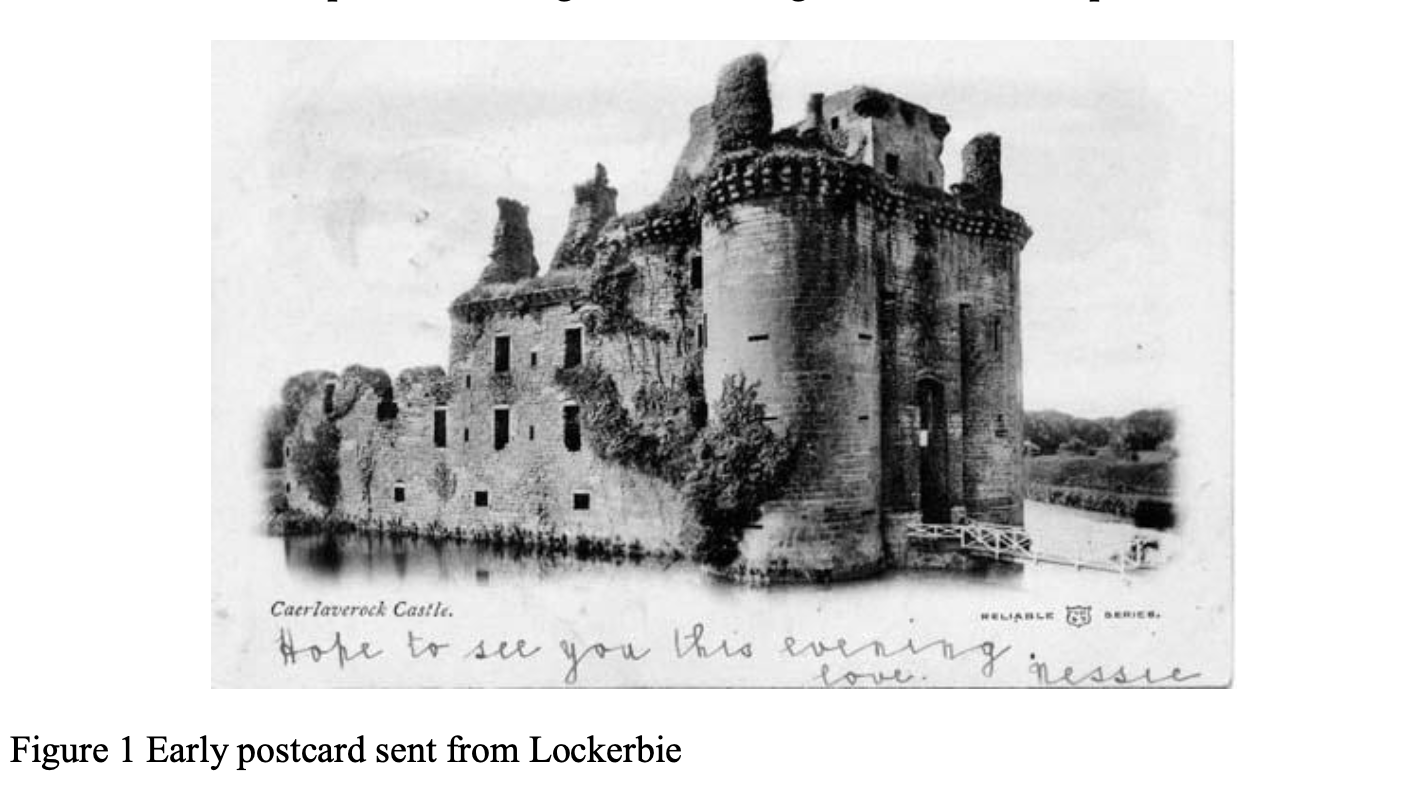
From “The Edwardian postcard: a revolutionary moment in rapid multimodal communications”:
In January 1902 the Post Office gave in to popular demand and permitted the use of postcards on which one side was wholly taken up by an image, and the other side had half address and half message. A cultural shift in everyday communications practices ensued; our investigations of the Postmaster General’s reports lead us to calculate that 5,920,933,334 of these cards were sent in the UK in the Edwardian age (the equivalent of 200 cards per person). With up to 10 deliveries a day in major cities, rapid responsivity was enabled in a simple, exceedingly cheap way.
So, even though it isn’t much space, we should be grateful for the space we have!
Those early postcards also offer us an insight into what we can write on our postcards:
[F]or many people the postcard was taken as an opportunity to write informally; they frequently make reference to the past or intended future writing of a letter as if contrasting the practice of dashing off a postcard against a letter. At the time, letter writing manuals were very common and there was a shared social sense bolstered of course through the formal education system that they should feature correct spelling, conventional orthography and grammatically standard English. Postcard writing was far more relaxed and often (although certainly not always) made use of a more conversational tone. Although the space on a card was obviously very limited, people varied in how they made use of the space. [From: The Edwardian Postcard]
In contrast to a formal letter, with rigid guidelines and proper structures, your postcard can be whatever you want it to be.
If you want to write like you’re texting… you can! If you want to write like you’re an author… you can! And if you want to write like it’s a term paper… that would be boring. Don’t do that.
What’s important to think about when writing is: who are you writing to? What would they like to receive? (This goes double when picking out the perfect postcard to send.)
I like to begin my postcards with a quick update on what I am doing. If you’re on vacation, this could be something catchy like: “Strolling King Street today.” “Spent the afternoon on Folly Beach.” “Traded my office chair for a Kiawah sand dune.”
I then try to fill in a few details. “Found the world’s best shrimp and grits.” “Tried an oyster I’ll never forget.” “Had an incredible meal at a beautiful little bistro.”
Lastly, I try to close with some fun and/or kind words. “Miss you more than ever — can’t wait to tell you every detail.” “Thinking of you and saving a sunset for when we’re together.“ “Sending calm and a small reminder you’re not alone.”
And that’s it. By this point, you’re probably out of room. Sign your name and send it off.
To sum it all up, a well-written postcard is short but thoughtful: pick a clear tone, share some memorable details, and end with a simple sign-off that fits your relationship. Keep it concise, avoid oversharing, and let the image on the front do some of the storytelling.
With a little attention to tone and a personal touch, your next postcard will feel like a small gift the recipient can keep.
— Adam